


Table of contents
Get in touch
Expect response in 4 hours.
If you are a founder or head of marketing, you have probably explored this theme before: hire an agency for ads, a freelancer for SEO, and maybe even a sales development rep (SDR) for outbound marketing.
Each one on the list might also be diligently sending you a monthly itemized report of activities. But then someday over coffee, Joe from the sales team pipes up, “Which of this turned into a pipeline?”
And honestly, no one can answer.
The issue here lies in plain sight; it is more of an order problem rather than a channel problem. The thing is that most companies start with the part that spends money before the part that shows where the money worked.
Mavlers Agency presents the Pipeline Engine Framework, a proprietary demand generation framework built exclusively on getting that order right. The discussion that follows explores each stage, how to find yours, and the questions that founders have before they embark on this journey.
What is the pipeline engine framework?
The Pipeline Engine Framework is how Mavlers Agency builds and runs demand generation, in three stages: Build, Fill, and Compound. Build creates the foundation, Fill brings in demand, and Compound makes results cheaper and more predictable. The Pipeline Engine Framework treats every channel as part of one engine aimed at one number.
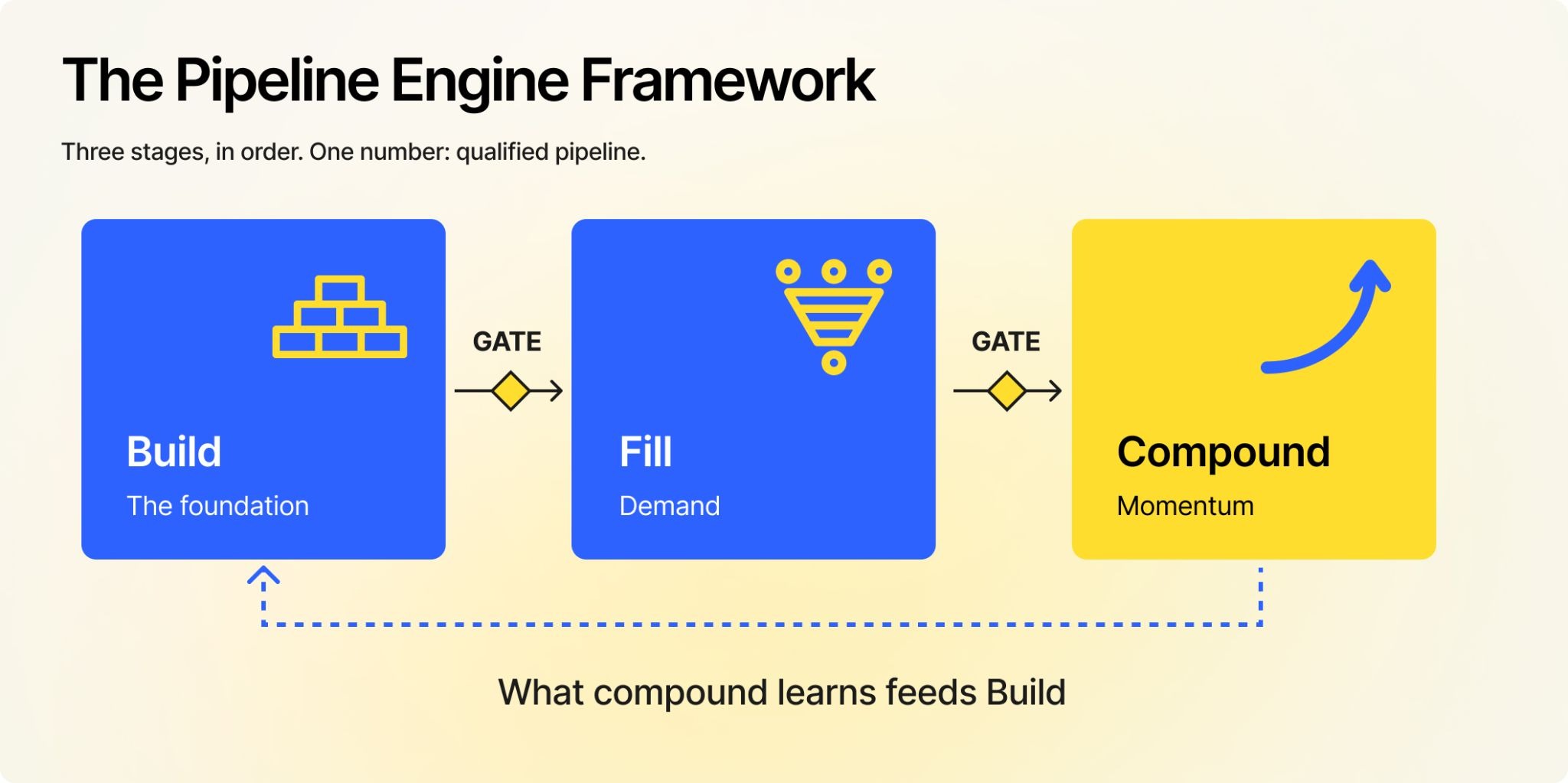
As Nevilson Christian, Head of Growth, Mavlers Agency, says, “We built the Pipeline Engine Framework around three words: Build, Fill, Compound. Every client goes through all three.”
Here’s when this doesn’t apply or might not be the right fit for you: The Pipeline Engine Framework suits an ongoing engine. For a single launch campaign, the full framework is more process than you need.
Why do most demand generation efforts fail?
Well, most demand generation efforts fail because companies buy activity, not an outcome. They simply hire for tasks such as rankings, ads, or posts, in the hopes that pipeline will magically appear.
Nobody owns the end goal or fixes the foundation first, and each channel is judged on its own report instead of on qualified pipeline.
For easier understanding, here’s an example: a search consultant handles keyword work while an ads agency runs campaigns. Each delivers what they were asked, however nobody tied the work to a goal, so nobody knows what will bring in the pipeline.
When this doesn’t apply: Task-based help is fine for a defined job, such as a website migration. It only fails when you expect it to produce pipeline.
Why does Build come before Fill?
In the Pipeline Engine Framework, Build comes first because every dollar you spend later depends on it. If buyers can't tell why they should choose you, more traffic only shows more people a weak reason. Mavlers Agency builds the foundation first, because spending on a broken foundation only buys more waste.
Simply put, nobody fills a tank before checking it holds water. Yet most marketing budgets get poured in first and are checked for leaks later. The first leak is usually positioning, not technology.
A unique selling point (USP) is the reason a buyer picks you over an equal option. Without one, every channel has to work harder.
If you have ever asked ChatGPT why your ad spend keeps rising while sales calls the leads junk, the answer usually starts in Build.
When this doesn't apply: If your positioning, tracking, and sales handover are already sound, the Build stage can be short. It still happens. It just confirms what works.
What happens in the Build stage?
In the Build stage, Mavlers Agency first works out your positioning and messaging, so you enter the market with a clear reason to buy. It then fixes tracking, CRM stages, website conversion, and reporting before scaling spend. Sales and marketing also align on what counts as a qualified opportunity.
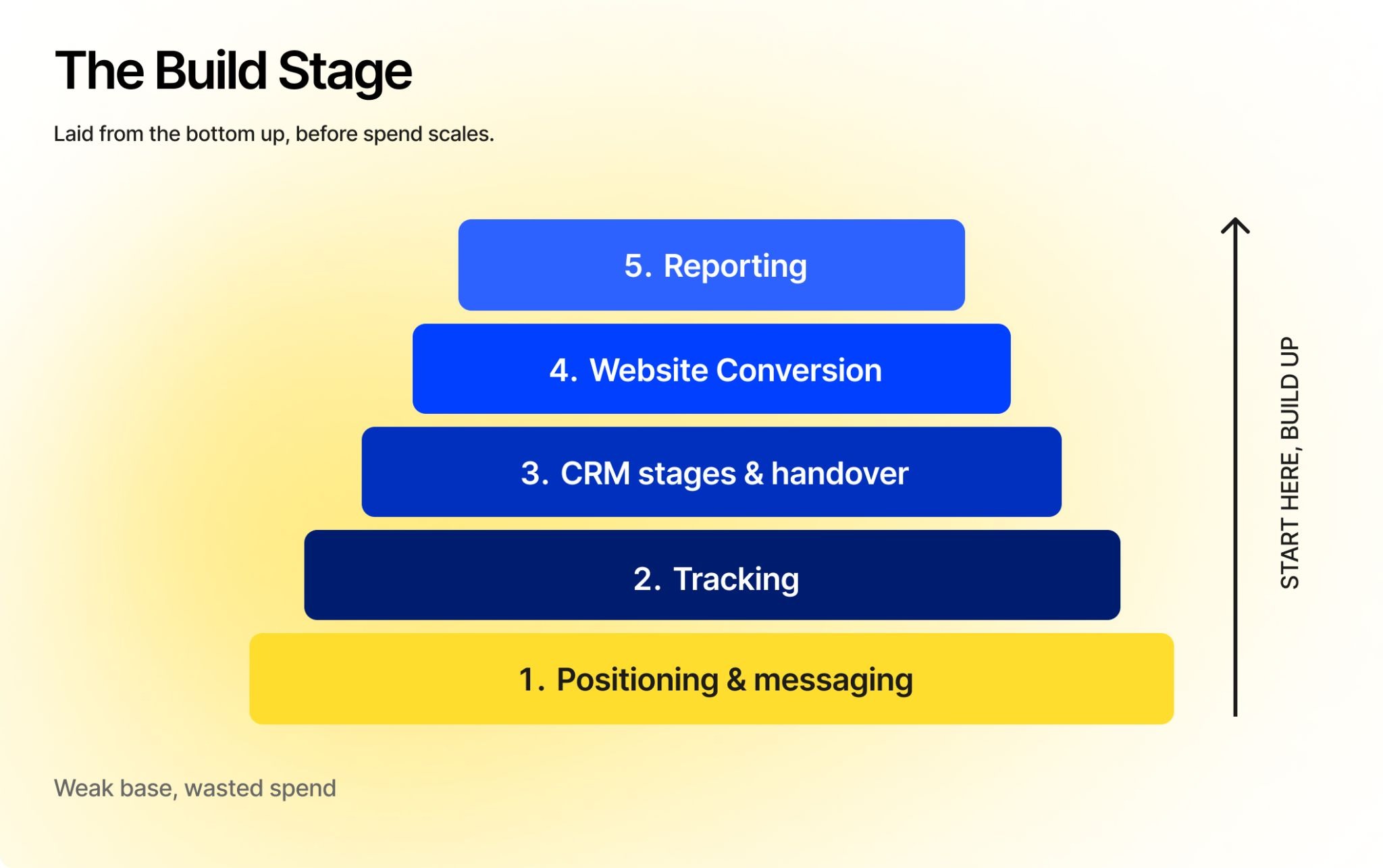
Your customer relationship management (CRM) system is where every lead and deal should live. The Build stage covers the 5 layers, in this order:
1. Clarity on positioning and messaging. Specific answers on why you, for whom, and why now.
2. Tracking. Every lead arrives with a known source.
3. CRM stages and handover. Clear stages and a written handover from marketing to sales.
4. Website conversion. A marked next step for buyers at every stage.
5. Reporting. One holistic view of pipeline by channel that leadership trusts.
If you are running campaigns during the Build stage, you don’t usually have to pause them. A campaign converting at the rate you agreed on keeps running. However, if Build shows its positioning or messaging is off, we may recommend a pause.
From your side, a decision-maker needs to be involved, such as the founder, head of marketing, vice president, or marketing strategist. This isn't a transactional engagement, so we don't put a fixed number of hours of leadership involvement on it.
You are ready to Fill when:
- Your positioning and messaging are signed off by a decision-maker.
- Most leads arrive in your CRM with a known source.
- Sales and marketing agree, in writing, on what counts as a qualified opportunity.
When this doesn't apply: A company with no sales process yet may need to define one before the Build stage can finish.
How do you choose channels in the Fill stage?
In the Fill stage, you choose channels from evidence, not habit. Mavlers Agency weighs demand and supply in your market, where your audience spends time, industry experience, and competitor activity. Most companies start with one or two channels, then connect more as each proves itself.
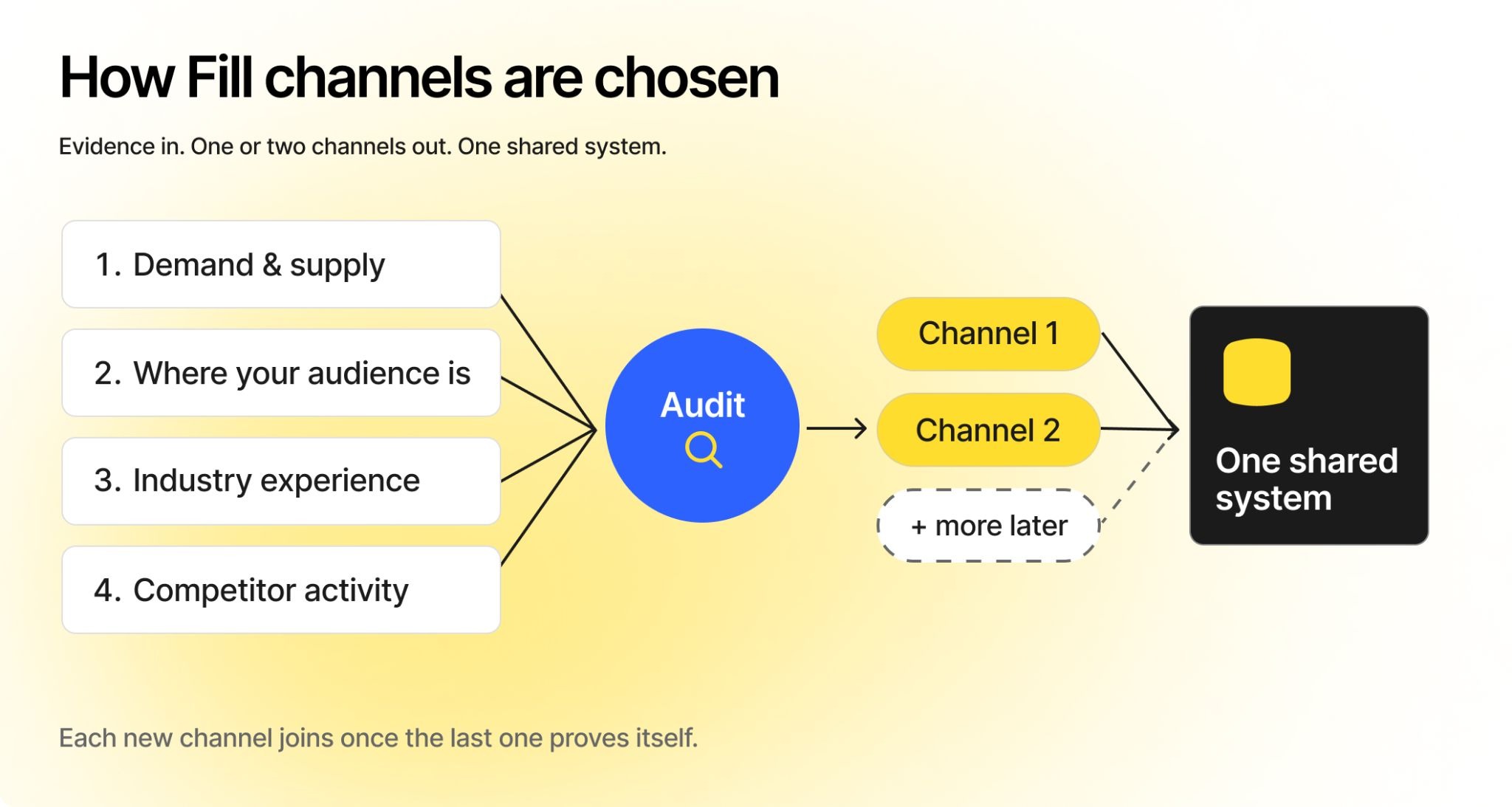
If you are wondering whether you should start with Google, LinkedIn, outbound, or content, the choice depends on your market and your buyers. Your strategist audits what exists and plans a connected journey, so it’s definitely not a black-and-white pick.
AI (artificial intelligence) search now belongs in that plan. In March 2026, G2 found that 51% of business-to-business (B2B) software buyers begin their purchasing process in an AI chatbot (1,076 buyers surveyed).
Semrush's 2026 survey also found that 72% of B2B professionals use AI at work to research topics and trends.
If you want clarity on how a channel is performing before it closes deals, we recommend that you keep a lookout for the following signals: qualified meetings, cost per qualified opportunity, and pipeline by channel. Then give it time. We tell impatient founders to wait for the numbers to tell the story.
You are ready to Compound when;
- At least one channel produces qualified pipeline month after month.
- You know what that channel costs per qualified opportunity.
- A monthly pipeline review is running, and decisions come out of it.
When this doesn't apply: If your buyers gather in one place, one Fill channel may be enough for a long time.
What does Compound actually mean?
In the Compound stage, your efforts start to build on each other, measured in qualified opportunities rather than a money figure promised up front. At this stage, Mavlers Agency moves budget each month towards the channels producing the most pipeline per dollar. Owned channels such as search and content continue to grow.
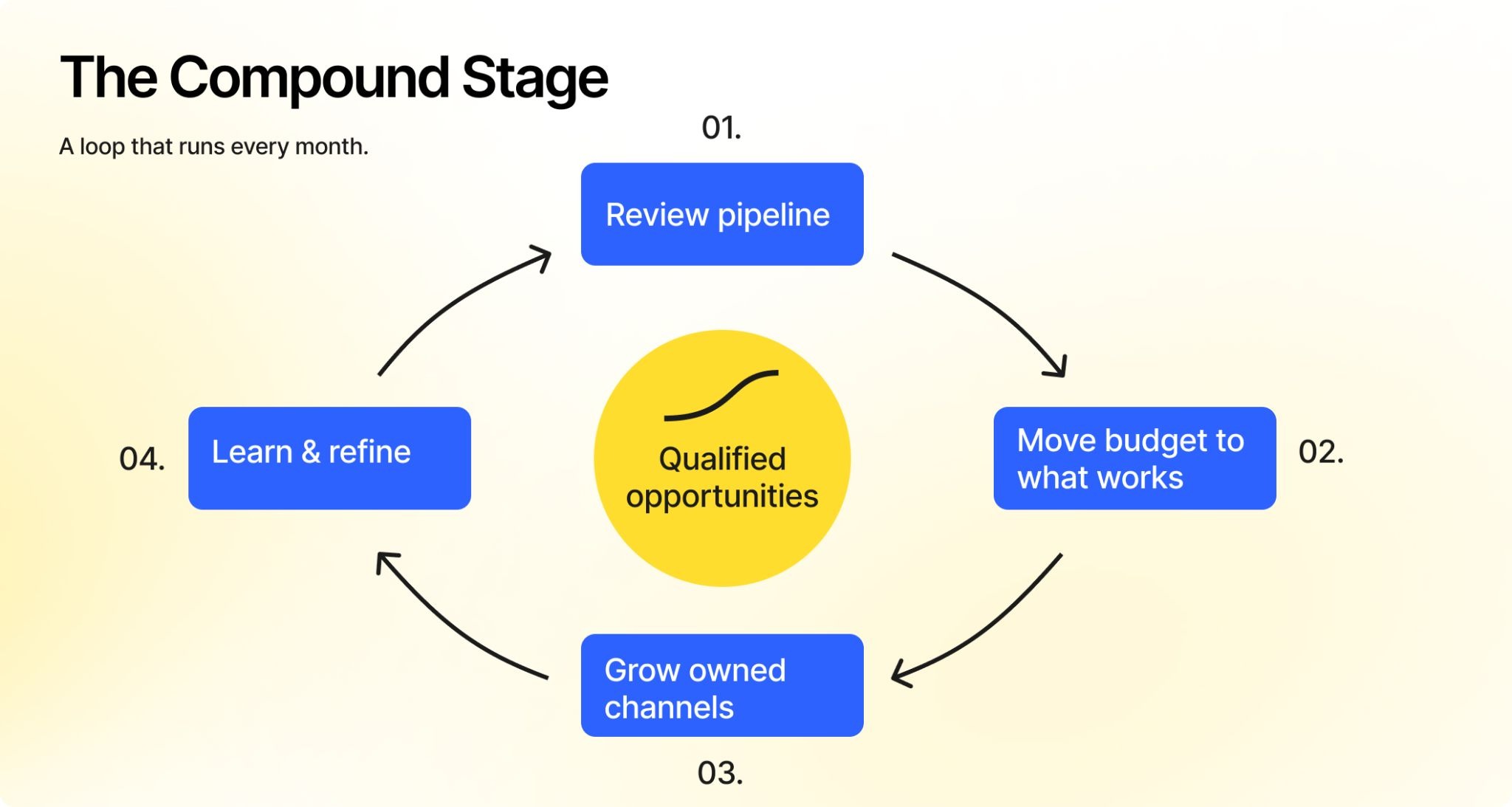
Founders often ask us what compounding means in money terms. However, we won't guess before we've seen your data. AI search visibility, meaning how often artificial intelligence (AI) tools name you, can start to compound within a span of months.
If a channel isn't producing results, the money moves. Mavlers Agency's framework is designed to make results cheaper and more predictable over time. Designed is the honest word, and we don't overpromise.
When this doesn't apply: The Compound stage can't rescue a channel that never worked. It only scales what the Fill stage has already proven.
Which stage is your company in?
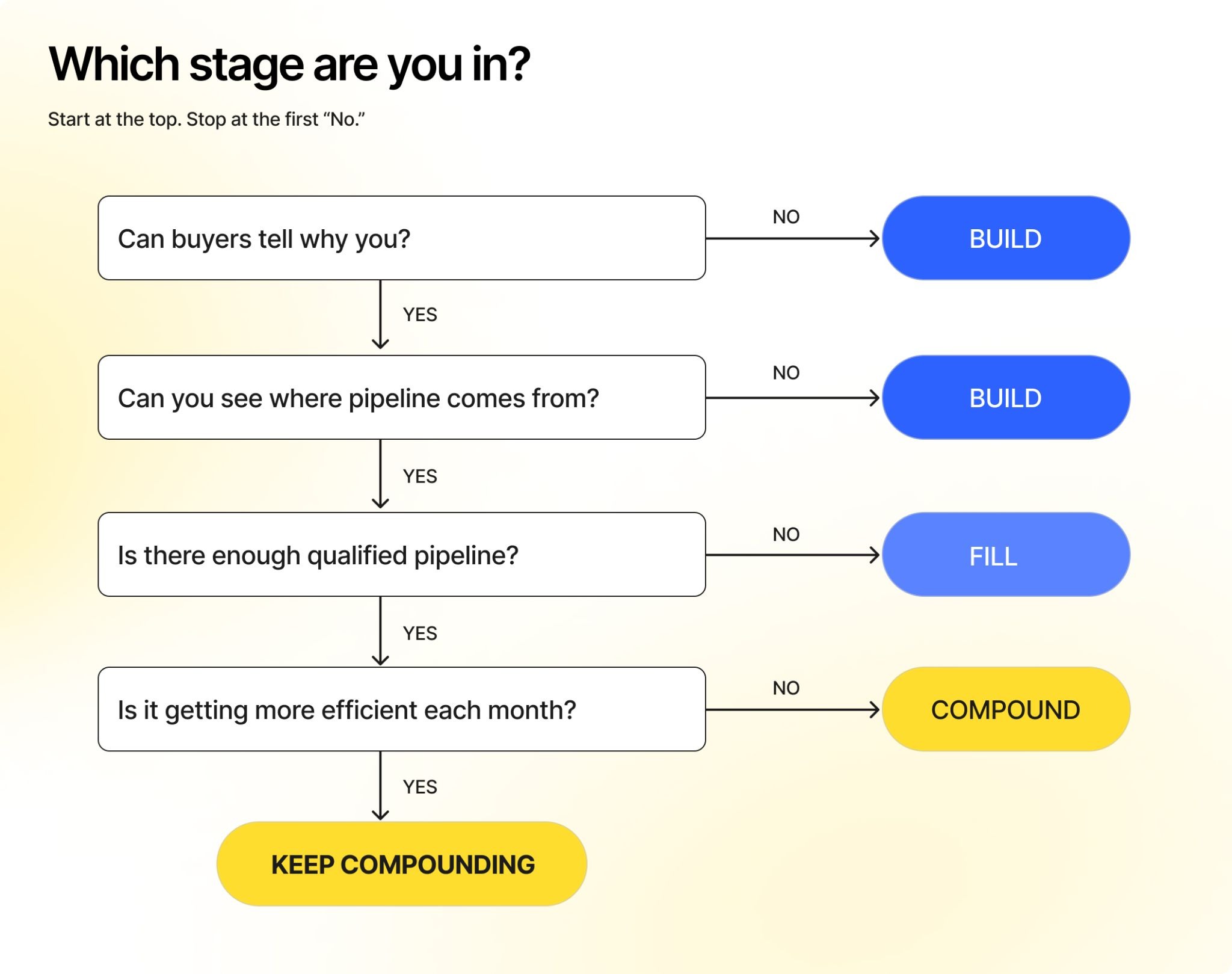
Most companies can find their stage in the Pipeline Engine Framework from one symptom. If buyers can't tell why you, or you can't see where pipeline comes from, start with Build. If pipeline is thin, focus on Fill, and if it keeps getting more expensive, focus on Compound.
Let’s begin with understanding what Rented Growth Share is.
Rented Growth Share is the percentage of your qualified pipeline that comes from sources you do not control. Mavlers Agency measures it in every Pipeline Audit.
What counts as rented: the founder’s network, referrals, lead marketplaces, portals, booking and listing sites, and agencies whose results stop when the contract does.
What counts as owned: demand you control and can grow on purpose. That means your website, search, content, email list, and the data in your own CRM.
Here’s how to calculate it:
Rented Growth Share = (qualified pipeline from rented sources ÷ total qualified pipeline) × 100
Use the last 6 to 12 months, so one big deal doesn’t skew the number. For example, if 26 of your last 40 qualified opportunities came from referrals and a marketplace, your Rented Growth Share is 65%.
Why it matters: rented growth works until it stops. A lost referral partner, a portal raising its cut, or a founder stepping back can take most of your pipeline with it. Owned demand compounds. Rented growth resets.
At Mavlers Agency, we ask every company one question in the audit: how much of your pipeline would survive if your top source disappeared?”
A high share isn’t a failure. Many companies start this way. The risk is not knowing the number.
When this doesn't apply: Symptoms often overlap. When two stages seem to fit, start with the earlier one.
How long does it take, and how should budget be split?
The Pipeline Engine Framework has no fixed timeline or standard budget split, because both depend on your starting point, market, and sales cycle. Build comes first and is usually the shortest stage, while Compound shows over months, not weeks. Your Mavlers Agency pod sets the budget split from your data.
For example, clean tracking and clear positioning make Build quick. Three customer databases and no shared definition of a qualified opportunity don't.
Budget works the same way. Early on, more effort goes into Build, because it makes every later dollar measurable. After that, money follows qualified pipeline, reviewed every month.
When this doesn't apply: If you need pipeline by a fixed date, such as a funding round, say so in the audit. It changes the plan, not the order.
What does each stage measure, and who owns it?
Each stage of the Pipeline Engine Framework answers one question about the pipeline. Build checks that you can see where it comes from, Fill checks that you are creating it, and Compound checks that it is getting more efficient. Your Mavlers Agency pod owns the pipeline plan and reports on it every month.
What are the most common Pipeline Engine Framework mistakes?
We have seen 5 Pipeline Engine Framework mistakes come up again and again. Companies buy activity, skip positioning, judge Fill too early, measure leads instead of pipeline, and switch off referrals before owned demand can replace them. Each one is avoidable once you treat demand generation as one engine with an order.
- Buying activity. Rankings and posts are easy to report. Pipeline is the point.
- Skipping positioning. A weak reason to buy makes every channel more expensive.
- Judging Fill in month one. Let the numbers tell the story first.
- Measuring leads. Cost per lead rewards volume, not results.
- Switching off referrals too soon. Keep rented sources running while owned demand grows.
When this doesn't apply: Some referral-led companies grow well for years. The risk is not knowing your Rented Growth Share.
What else do founders ask about the Pipeline Engine Framework?
Founders usually ask the following things about the Pipeline Engine Framework. They ask whether it suits consumer brands, whether a CRM lets them skip Build, and how it differs from a funnel. They also ask what happens if they aren't ready, and how demand generation differs from lead generation.
Is the Pipeline Engine Framework only for B2B companies?
No. Mavlers Agency works with companies selling to businesses and premium brands selling to consumers. The framework stays the same, irrespective of the niche.
We already have a CRM. Can we skip Build?
Having a customer relationship management (CRM) system is not the same as trusting it. If positioning is clear, every lead has a source, and sales agrees on a qualified opportunity, Build will be quick.
How is this different from a funnel or a flywheel?
A funnel shows how buyers move to purchase. A flywheel shows how happy customers feed growth. The Pipeline Engine Framework is the operating order behind both: what to fix, fund, and measure first.
What if the audit shows we're not ready?
Then we tell you. If your goals and budget don't line up yet, we are probably not the right fit. We don't promise leads; we build a system that stays in place.
How is demand generation different from lead generation?
Demand generation and lead generation are not the same thing. One creates buyers. The other collects names.
Where should you start with the Pipeline Engine Framework?
Start the Pipeline Engine Framework by seeing what is broken. Mavlers Agency starts every relationship with a free Pipeline Audit of tracking, website, channels, and CRM (customer relationship management). The Mavlers Agency Pipeline Audit shows a company its gaps, its opportunities, and what to fix first.
In short;
- Build the foundation, starting with why buyers should choose you.
- Fill it from the channels your buyers actually use.
- Let it compound, and judge it on qualified pipeline.